The Folded Page
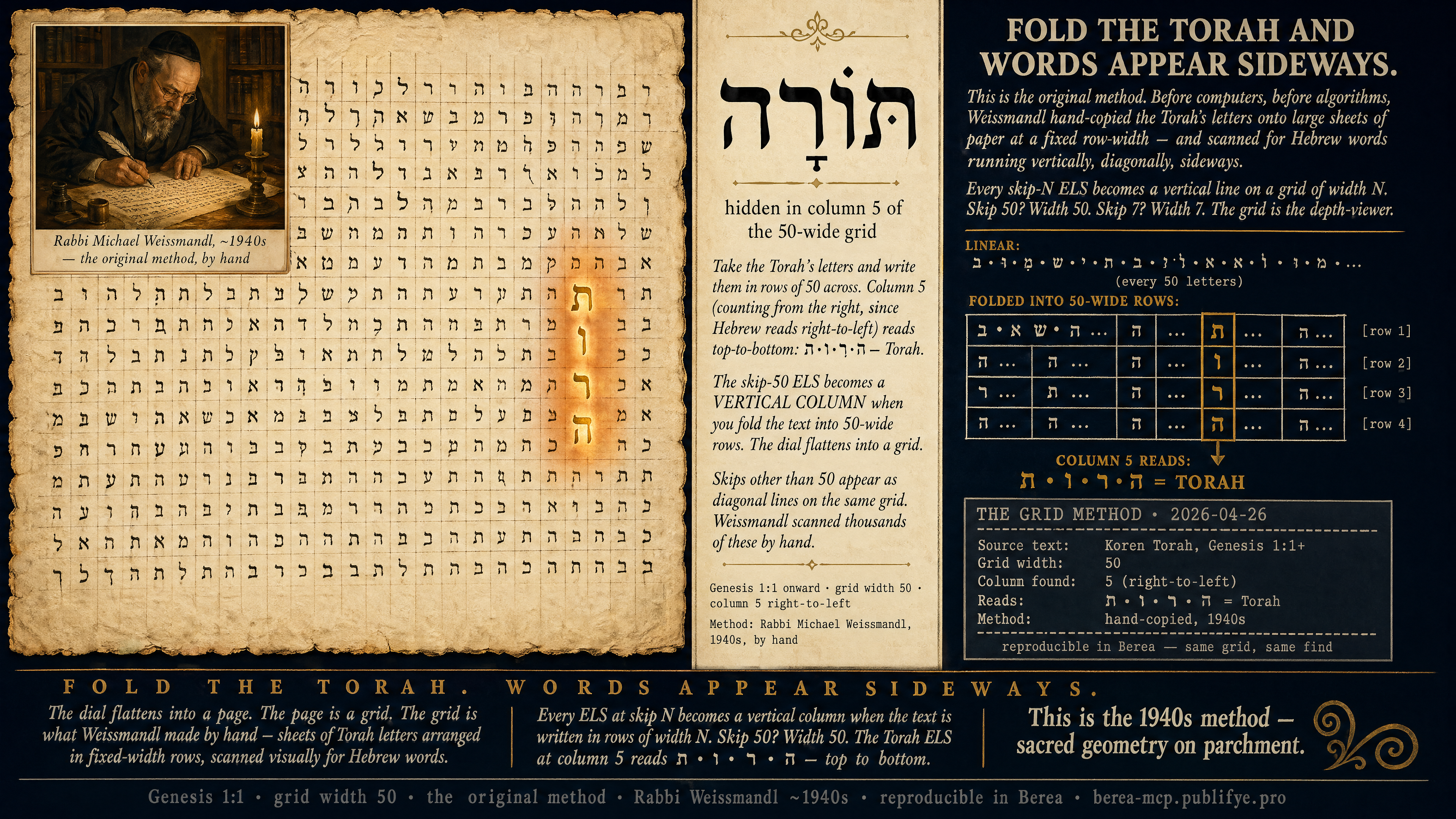
The second lens-view from the Cone. Hand-drawn parchment grid filling the page — Hebrew letters of Genesis 1:1 onward written in rows of 50 across, in the 1940s pen-and-paper method. Column 5 (right-to-left) glows gold, reading top-to-bottom: ת·ו·ר·ה — Torah. The original method that birthed the field; Berea's els_grid is its computational equivalent.
What this poster is
The second lens-view from the Cone (00B). The dial of poster 00C unwound onto a flat parchment page. Fold the Torah's letter stream into rows of fixed width and ELS codes become VERTICAL columns or DIAGONAL lines. This is the original method — Rabbi Michael Weissmandl wrote out the Torah by hand in 1940s grid patterns and scanned visually for hidden words.
The teaching
An ELS at skip N becomes a perfectly vertical column when the text is written in rows of width N. ELS at other skips become diagonal lines. The grid is the depth-viewer for hidden patterns.
For the תורה finding (skip 50, Genesis 1:1, position 5):
- Row 1 contains positions 0–49 — letter 5 (ת) sits in column 5 (counting from the right, since Hebrew reads right-to-left)
- Row 2 contains positions 50–99 — letter 55 (ו) sits in the SAME column 5
- Row 3 — letter 105 (ר) — column 5
- Row 4 — letter 155 (ה) — column 5
Reading column 5 top-to-bottom: ת · ו · ר · ה — Torah.
Why it matters
This is the method that birthed the field. Pen, paper, and a ruler. No computer. The grid makes hidden patterns visible by physical alignment — a typographic depth-viewer. Berea's els_grid function is a direct computational descendant of Weissmandl's hand-drawn parchment sheets.
Reproducibility
berea call els_grid start_pos=0 width=50 max_rows=20
Returns a 20-row × 50-letter grid with column 5 (right-to-left) revealing ת · ו · ר · ה for the Genesis 1:1 Torah ELS.
Visual hinge
A large parchment sheet covered in hand-written Hebrew letters arranged in 50-wide rows. One column glows gold — top to bottom: ת · ו · ר · ה — Torah. Weissmandl in candlelight, copying letters by hand — the way it was done before computers existed.
Citations
- Rabbi Michael Ber Weissmandl (1903–1957), the original hand-drawn Torah-grid method.
- Berea
els_gridandels_grid_imagefunctions are the computational equivalent.
Source
Render: OpenAI Image 2 (gpt-image-2), 2026-04-26 18:52 CEST, single-pass landing.