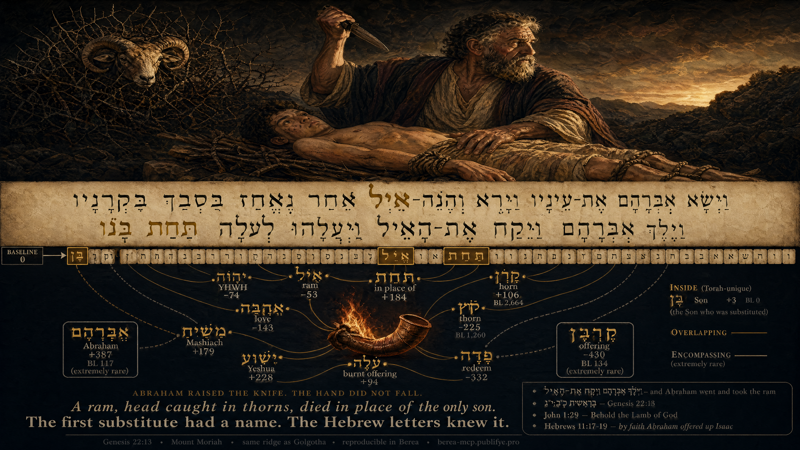
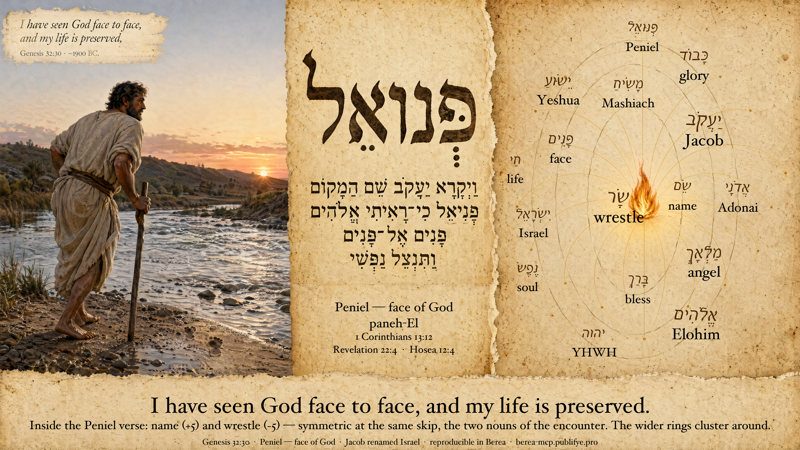
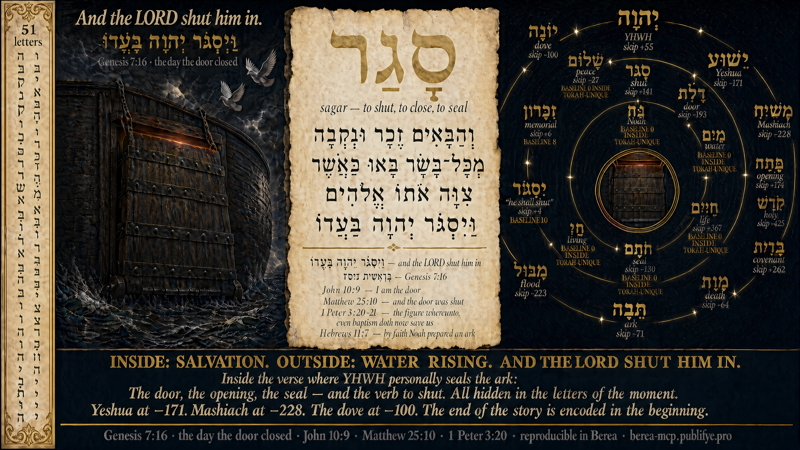
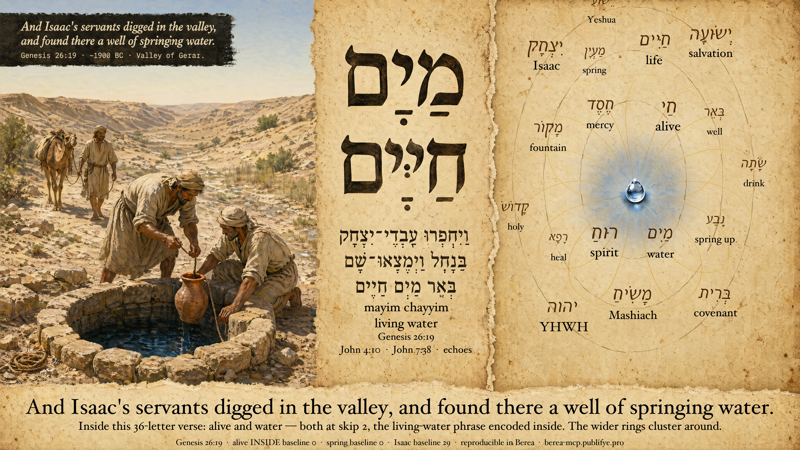
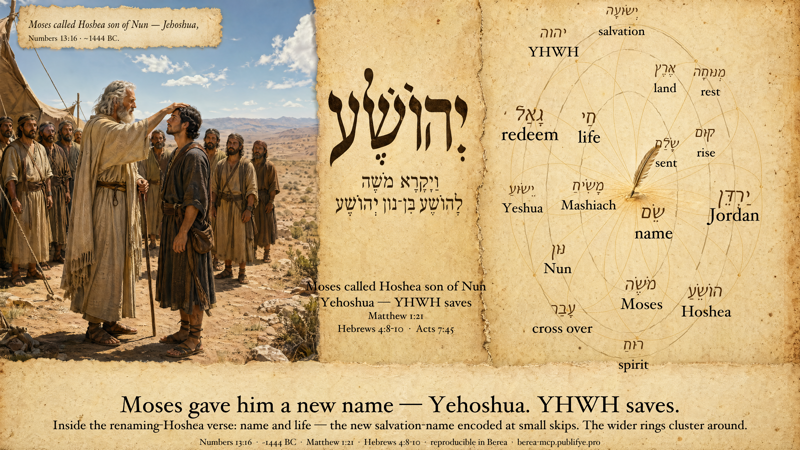
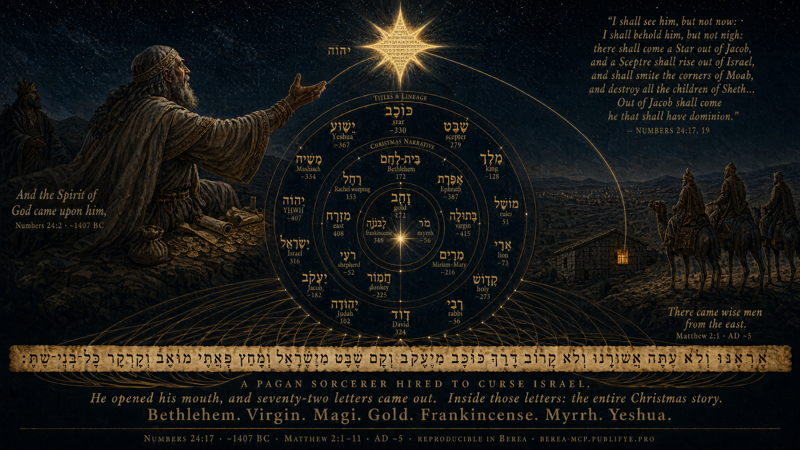
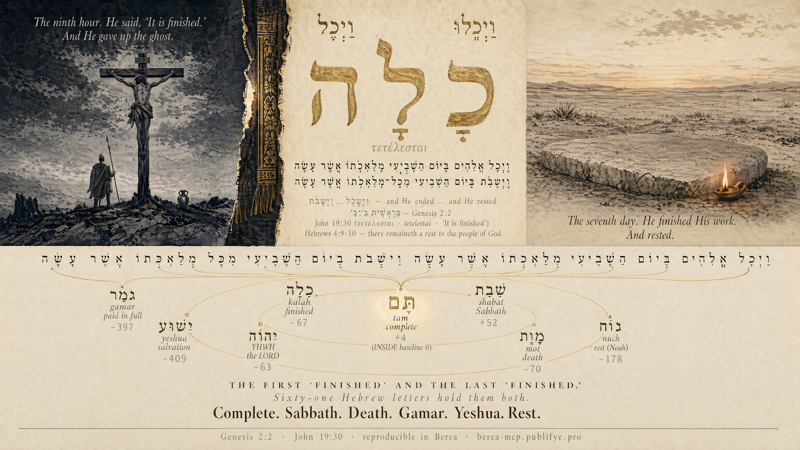
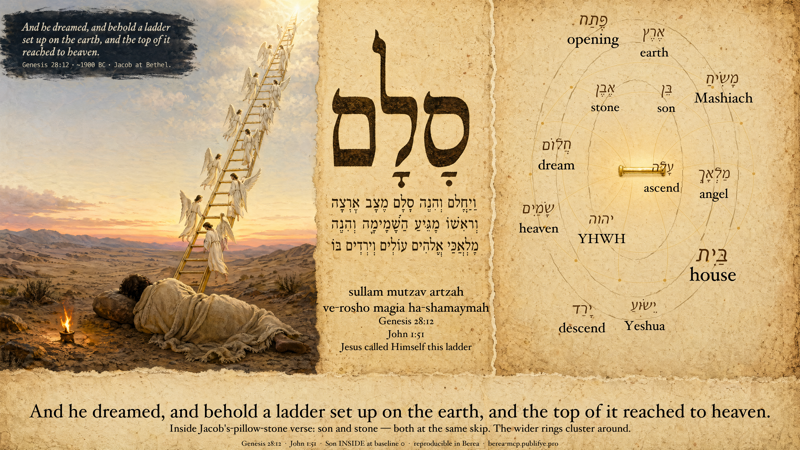
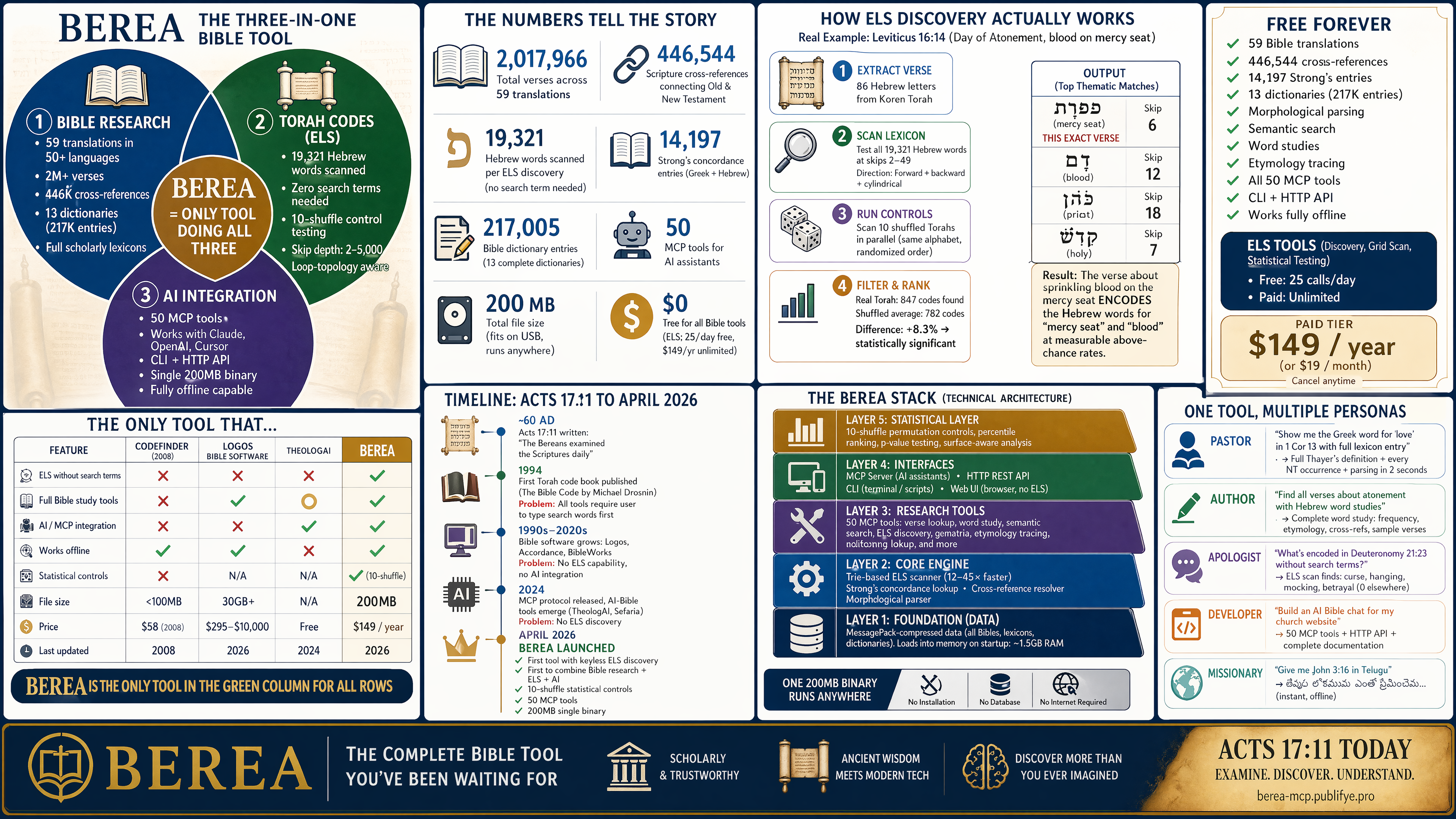
Every example below is real output from Berea — returned by a single MCP tool call from your AI assistant. Each card shows the exact command. Click any card for the full analysis.
word_study(number="G26")
αγάπη (agapē) — G26
"God is love" (1 John 4:8) — but which kind of love?
| Source | What Berea returns |
|---|
| Abbott-Smith | “Love which chooses its object” — distinct from φιλία (friendship), στοργή (natural affection), ἔρως (sexual love — never used in the NT) |
| LSJ | Virtually nonexistent outside biblical literature. Christians essentially invented this word. |
| Frequency | 106 occurrences — all NT. Zero OT (Hebrew uses אהבה ahavah instead) |
One word_study call. Three scholarly lexicons. The English "love" covers four Greek words. Only one was chosen for God.
word_study(number="H2617")
חסד (ḥesed) — H2617
"His mercy endureth for ever" (Psalm 136) — but "mercy" is a mistranslation
| Source | What Berea returns |
|---|
| Strong’s | Kindness, piety, mercy, lovingkindness — no single English word covers it |
| Usage | Translated 12 different ways in the KJV: mercy, kindness, lovingkindness, favour, goodness… |
| Frequency | 241 occurrences across the OT. Gematria: ח(8) + ס(60) + ד(4) = 72 |
חסד is covenant loyalty — the word for God's character that refuses to abandon. No English word is big enough.
get_morphology(ref="Hebrews 4:12")
Hebrews 4:12 — Surgical Morphology
"The word of God is living and active, sharper than any two-edged sword."
| Greek | Parsing | Significance |
|---|
| ζών | Verb, Present, Active, Participle | Not “alive” (adjective) — actively living right now |
| ἐνεργής | Adjective, Nominative | Root: ἐν (in) + ἔργον (work) — “at work within” |
| τομώτερος | Adjective, Comparative | “More cutting than” — not just sharp, sharper-than |
| κριτικός | Adjective, Nominative | Root of English “critic” — the word of God is the original critic |
ζών is a present active participle — the word is not merely alive, it is living and acting as you read. Berea parses all 32 words in this verse.
multi_dict_lookup(query="grace")
“Grace” — 8 Dictionaries, One Call
multi_dict_lookup query="grace" — Berea searches all 13 dictionaries simultaneously
| Dictionary | What it adds |
|---|
| ISBE | 4,200-word article tracing grace from OT to NT — “the elasticity of the word enabled it to receive a new, technically Christian meaning” |
| Torrey | Structured topical: source, nature, effects. 40+ cross-references organized by theme. |
| ATS | “Grace in man, or all true holiness, is traced up to the grace of God as its only source” |
| Hawker | “Grace acts from itself to itself; nothing of human power disposing to it, nor of unworthiness keeping from it” |
8 dictionaries returned results for “grace.” One call. Fausset, Easton, Nave’s, Smith’s, Webster’s 1828, Thayer — all at once.
word_study(number="G4102")
πίστις (pistis) — G4102
"Your faith has made you whole" (Matthew 9:22) — but faith is not what you think
| Source | What Berea returns |
|---|
| Abbott-Smith | “Faith, belief, trust, confidence” — from root πείθω (to persuade). Active: trust in God. Passive: faithfulness. Objective: the faith (the body of belief). |
| LSJ | In secular Greek: trust, good faith, a guarantee, a pledge. In commercial use: credit. Pythagoras used it as a name for the number ten. |
| Frequency | 228 occurrences — all NT. The most frequent theological noun in the New Testament. |
πίστις has three meanings operating simultaneously: trust (active), faithfulness (passive), and doctrine (objective). English “faith” flattens all three into one.
word_study(number="G4982")
σώζω (sōzō) — G4982
"He shall save his people from their sins" (Matthew 1:21)
| Source | What Berea returns |
|---|
| Abbott-Smith | To save from peril, injury, suffering. To heal, restore to health. In NT: salvation from spiritual death — past (Eph 2:5), present (1 Cor 1:18), and future (Rom 13:11). |
| Thayer | From root σῶς (sōs, “safe”). Same root gives us σῶμα (body) and σωτήρ (savior). |
| Frequency | 103 NT occurrences. Translated “save,” “heal,” “make whole” — three English words for one Greek concept. |
When Jesus “heals” and “saves,” it is the same word: σώζω. Physical healing and spiritual salvation are one act in the Greek. The English separates what the original unites.
word_study(number="G3341")
μετάνοια (metanoia) — G3341
"Repent, for the kingdom of heaven is at hand" (Matthew 3:2)
| Source | What Berea returns |
|---|
| Abbott-Smith | “After-thought, change of mind, repentance.” From μετά (after) + νοῦς (mind). Not remorse — that is μεταμέλομαι (Judas in Matthew 27:3). |
| LSJ | Secular Greek: “afterthought, correction.” Thucydides uses it for changing a political decision. |
| Frequency | 24 NT occurrences. Gematria by isopsephy: μ(40)+ε(5)+τ(300)+α(1)+ν(50)+ο(70)+ι(10)+α(1) = 477. |
“Repent” sounds emotional. The Greek is intellectual: change your mind. Not “feel sorry” but “think differently.” Judas felt remorse (μεταμέλομαι). Peter changed his mind (μετάνοια). Different words. Different outcomes.
word_study(number="H7965")
שלום (shālōm) — H7965
"The LORD lift up his countenance upon thee, and give thee peace" (Numbers 6:26)
| Source | What Berea returns |
|---|
| Strong’s | Safe, well, happy, friendly. Welfare, health, prosperity, peace. From root שלם (shalam) — to be complete, to make whole. |
| BDB | Completeness, soundness, welfare, peace, quiet, contentment, friendship, peace from war. Seven distinct senses. |
| Frequency | 208 OT occurrences. Gematria: ש(300)+ל(30)+ו(6)+ם(40) = 376. Root also gives שלם (shelem, peace offering) and ירושלים (Jerusalem). |
שלום is not the absence of conflict. It is the presence of wholeness. The root שלם means “to be complete.” Peace is completeness. Jerusalem is “the city of completeness.”
word_study(number="H571")
אמת (ʾemet) — H571
"I am the way, the truth, and the life" (John 14:6)
| Source | What Berea returns |
|---|
| Strong’s | Stability, certainty, truth, trustworthiness. From root אמן (aman) — to be firm, to support, to be faithful. Same root gives us “Amen.” |
| Frequency | 125 OT occurrences. Gematria: א(1)+מ(40)+ת(400) = 441 = 21². The first and last letters of the Hebrew alphabet (א and ת) frame מ (water/chaos) between them. |
אמת is not abstract truth. It is structural reliability — something you can lean on. When Jesus says “I am the truth,” the Hebrew behind it means “I am the firm ground.” And “Amen” comes from the same root.
get_morphology(ref="Philippians 2:6")
Philippians 2:6 — The Kenosis
"Who, being in the form of God, thought it not robbery to be equal with God."
| Greek | Parsing | Significance |
|---|
| μορφή | Noun, Dative, Feminine | “Form” — not σχῆμα (outward shape). The essential, inner nature. |
| ὑπάρχων | Verb, Present, Active, Participle | “Existing” — continuous, ongoing. Not “was” but “being.” |
| ἁρπαγμόν | Noun, Accusative | “Something to be grasped/seized” — not “robbery.” He did not clutch at equality; he already had it. |
| ισα | Adjective, Accusative Plural Neuter | “Equal things” — not “equal to” but sharing the same attributes. |
ἁρπαγμόν is the key: not “robbery” but “a thing to be clutched.” He didn’t grasp at equality with God — he emptied himself of it voluntarily. The English hides the voluntary nature of the act.
get_morphology(ref="Romans 8:28")
Romans 8:28 — Parsing Changes Everything
"All things work together for good to them that love God."
| Greek | Parsing | Significance |
|---|
| αγαπῶσιν | Verb, Present, Active, Participle, Dative, Plural | “To those presently and actively loving” — not past tense. Not “loved once.” |
| συνεργεῖ | Verb, Present, Active, Indicative, 3rd Singular | συν (together) + ἔργον (work) — “co-works.” Root of English “synergy.” |
| κλητοῖς | Adjective, Dative, Plural | “Called ones” — from καλέω (to call). Root of English “church” (ἐκκλησία, the called-out). |
συνεργεῖ is present tense — God is co-working right now. αγαπῶσιν is a present participle — to those who are actively loving. Both present. Both active. Both ongoing. The verse is not a memory. It is happening.
get_cross_refs(ref="John 3:16")
John 3:16 — 35 Cross-References
"For God so loved the world, that he gave his only begotten Son."
| Connection | Reference |
|---|
| The father offering his son | Genesis 22:2, 12, 16 |
| God’s love demonstrated | Romans 5:8, 8:32 |
| The Lamb of God | John 1:29 |
| Reconciliation | 2 Corinthians 5:19–21 |
| Eternal life defined | John 11:25–26, 1 John 5:13 |
35 cross-references from the most quoted verse in the Bible. Genesis 22 (Abraham offering Isaac) appears three times — the Torah foreshadows the giving of the Son.
get_cross_refs(ref="Psalm 22:1")
Psalm 22:1 — 23 Cross-References
"My God, my God, why hast thou forsaken me?" — Jesus’ words on the cross (Matthew 27:46)
| Connection | Reference |
|---|
| Jesus quoting this psalm | Matthew 27:46, Mark 15:34 |
| The Psalm continues — pierced hands/feet | Psalm 22:16 |
| Gethsemane agony | Luke 22:44, Hebrews 5:7 |
| God does not abandon | Hebrews 13:5, Psalm 37:28 |
Jesus didn’t cry out in despair. He was quoting a psalm that begins in agony and ends in triumph (Psalm 22:22–31). Every Jew hearing him would have known the ending. One cross-reference call reveals the full picture.
strongs_in_verse(ref="John 14:6")
John 14:6 — Every Word Identified
"I am the way, the truth, and the life: no man cometh unto the Father, but by me."
| Greek | Strong’s | Definition |
|---|
| ὁδός | G3598 | A road, a journey, a mode/means — not just “way” but the route itself |
| ἀλήθεια | G225 | Truth — from ἀ (not) + λήθω (to hide). Literally: “the unhidden” |
| ζωή | G2222 | Life — not βίος (biological life). Eternal, divine quality of life. |
ἀλήθεια is literally “un-concealment” — truth as revelation, not as proposition. ζωή is not βίος (the span of life). It is the quality of life that belongs to God. Three words. Three Greek roots. None of them mean what the English suggests.
strongs_in_verse(ref="Colossians 1:16")
Colossians 1:16 — The Architecture of Creation
"By him were all things created, that are in heaven, and that are in earth, visible and invisible."
| Greek | Strong’s | Definition |
|---|
| κτίζω | G2936 | To fabricate, to found, to form originally — creation ex nihilo |
| θρόνος | G2362 | Thrones — seats of power |
| κυριότης | G2963 | Dominions — lordships, ruling authorities |
| ἐξουσία | G1849 | Authorities — delegated power. Root of “exorcism.” |
Four categories of invisible powers: thrones, dominions, principalities, authorities. Paul names the hierarchy. One verse, 19 Greek words identified by Berea. The architecture of the unseen world laid out in one sentence.
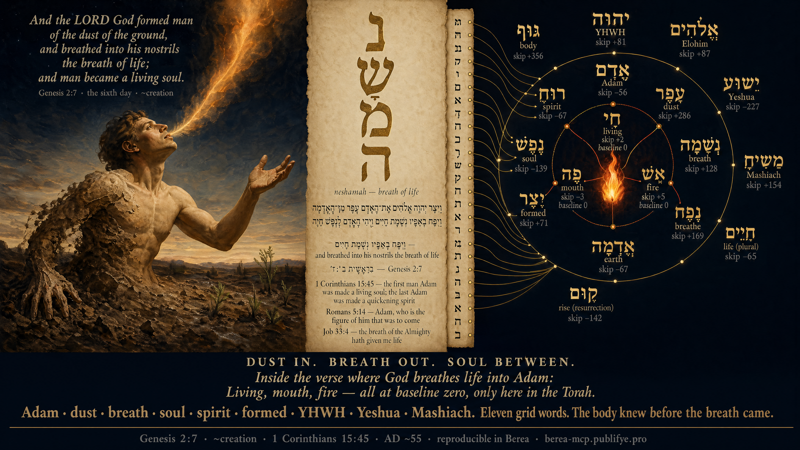
word_study(number="H5315")
נפש (nephesh) — H5315
"And man became a living soul" (Genesis 2:7)
| Source | What Berea returns |
|---|
| BDB | 10 distinct senses: breathing creature, living being, self, person, desire, appetite, emotion, passion, seat of the will, the man himself. |
| Root | From נפש (napash, H5314) — to breathe, to be refreshed. The soul is “that which breathes.” |
| Frequency | 683 occurrences — the most frequent anthropological term in the OT. Gematria: נ(50)+פ(80)+ש(300) = 430 — same as אלהים (Elohim). |
נפש is not the Greek “soul” (immaterial ghost in a body). It is the whole breathing creature. Genesis 2:7: man did not receive a nephesh — he became one. And its gematria equals Elohim.
word_study(number="H7307")
רוח (ruach) — H7307
"And the Spirit of God moved upon the face of the waters" (Genesis 1:2)
| Source | What Berea returns |
|---|
| BDB | Wind, breath, mind, spirit. Sub-meanings: animation, courage, temper, anger, prophetic spirit, Spirit of God — “never referred to as a depersonalized force.” |
| Root | From רוח (ruach, H7306) — to blow, to breathe, to perceive, to enjoy. |
| Frequency | 348 OT occurrences. Gematria: ר(200)+ו(6)+ח(8) = 214. Translated “spirit” (232×), “wind” (92×), “breath” (27×). |
English has three words for one Hebrew reality: spirit, wind, and breath are all רוח. When the Spirit “moved upon the waters” in Genesis 1:2, the same word describes God breathing on chaos.
word_study(number="H1350")
גאל (gaʾal) — H1350
"I know that my Redeemer liveth" (Job 19:25) — but “redeemer” is a legal term
| Source | What Berea returns |
|---|
| BDB | To redeem according to the law of kinship: buy back a relative’s property, marry his widow, avenge his death, ransom him from slavery. |
| Context | Boaz is Ruth’s גאל (kinsman-redeemer). God is Israel’s גאל from Egypt (Exodus 6:6). The Angel is Jacob’s גאל from evil (Genesis 48:16). |
| Frequency | 84 OT occurrences. Gematria: ג(3)+א(1)+ל(30) = 34. |
The גאל must be a blood relative with the right, the resources, and the willingness to redeem. Not any savior — a kinsman. This is why the incarnation matters: the redeemer must be family.
word_study(number="H3467")
ישע (yashaʿ) — H3467
"The LORD saved Israel that day" (Exodus 14:30) — and the name of Jesus
| Source | What Berea returns |
|---|
| BDB | “To be open, wide, free — to be safe. To give width and breadth to, to liberate.” Salvation is spaciousness — the opposite of constriction. |
| Derivatives | ישועה (Yeshuah, salvation). ישוע (Yeshua — Jesus). The name Jesus means “YHWH saves.” |
| Frequency | 198 OT occurrences. Gematria: י(10)+ש(300)+ע(70) = 380. ישוע (Yeshua) = 10+300+6+70 = 386. |
Salvation in Hebrew is not rescue from danger. It is being brought into wide-open space. ישע means to make spacious, to set free. And the name Yeshua — Jesus — is built from this root. His name IS the verb.
word_study(number="G3875")
παράκλητος (paraklētos) — G3875
"I will send you another Comforter" (John 14:16) — but “Comforter” is misleading
| Source | What Berea returns |
|---|
| Abbott-Smith | “Called to one’s aid in a judicial cause. An advocate, pleader, intercessor — a friend of the accused, called to speak to his character.” |
| LSJ | Legal assistant, advocate (Demosthenes, 4th c. BC). Not “comforter” — a courtroom defender. |
| Frequency | Only 5 occurrences in the entire NT. 4× for the Holy Spirit (John 14–16). 1× for Christ (1 John 2:1). |
The Holy Spirit is not a “comforter” who pats your head. He is a παράκλητος — a legal advocate who stands in court and speaks in your defense. And Jesus says “another” (αλλος, same kind) — another advocate of the same type as himself.
strongs_in_verse(ref="Psalm 23:1")
Psalm 23:1 — Three Hebrew Words
"The LORD is my shepherd; I shall not want."
| Hebrew | Strong’s | Definition |
|---|
| יהוה | H3068 | YHWH — the self-existent, eternal one. The divine name. |
| רעה | H7462 | To tend a flock, to pasture, to rule, to associate as a friend. |
| חסר | H2637 | To lack, to fail, to want, to lessen. |
The most beloved verse in the Bible is three Hebrew words: YHWH, shepherd, lack. רעה means both “shepherd” and “friend” — the shepherd is not distant authority but intimate companion. And חסר is absolute: nothing lacking. Nothing.
strongs_in_verse(ref="Revelation 1:8")
Revelation 1:8 — The Alpha and Omega
"I am Alpha and Omega, the beginning and the ending, saith the Lord."
| Greek | Strong’s | Definition |
|---|
| Α | G1 | Alpha — the first letter. Numerically: 1. |
| Ω | G5598 | Omega — the last letter. “The finality.” |
| παντοκράτωρ | G3841 | The All-Ruler — παν (all) + κράτος (power). Absolute sovereignty. |
| ὤν | G5607 | “The Being” — present participle of “to be.” He who IS. |
παντοκράτωρ appears 10× in the NT — 9 in Revelation. It translates the Hebrew צבאות (tseva’ot, “of hosts/armies”). The Lord of Armies is the All-Ruler. And ὤν — “the one who is” — echoes Exodus 3:14: I AM.
get_cross_refs(ref="Genesis 1:1")
Genesis 1:1 — 78 Cross-References
"In the beginning God created the heavens and the earth."
| Connection | Reference |
|---|
| The Word was in the beginning | John 1:1–3 |
| By him all things were created | Colossians 1:16–17 |
| Through faith we understand | Hebrews 11:3 |
| His invisible attributes — creation reveals | Romans 1:19–20 |
| Before the mountains were brought forth | Psalm 90:2 |
78 cross-references from the first verse of the Bible — the most connected verse in the OT. Seven Hebrew words generate a 78-node network spanning to Revelation 22:13. One call.
get_morphology(ref="Isaiah 9:6")
Isaiah 9:6 — David’s Throne, Forever
"Of the increase of his government and peace there shall be no end, upon the throne of David."
| Hebrew | Parsing | Significance |
|---|
| כסא | Noun, Masculine, Construct | Throne — seat of authority (H3678) |
| דוד | Proper Noun | David — the royal line. Gematria: ד(4)+ו(6)+ד(4) = 14. |
| עולם | Noun, Masculine, Absolute | Forever, eternity (H5769). This reign has no expiration. |
| צבאות | Noun, Both, Plural | Hosts/armies (H6635). YHWH of armies will accomplish this. |
David’s gematria is 14. Matthew 1:17 counts 14 generations × 3 from Abraham to Christ. The number of the name structures the genealogy. And צבאות — YHWH will use his armies to establish this kingdom.
get_cross_refs(ref="Romans 3:23")
Romans 3:23 — 17 Cross-References
"For all have sinned, and come short of the glory of God."
| Connection | Reference |
|---|
| Creation was “very good” | Genesis 1:31 |
| All our righteousness as filthy rags | Isaiah 64:6 |
| No one righteous, not even one | Ecclesiastes 7:20 |
| If we say we have no sin | 1 John 1:8–10 |
| God shut all under sin | Galatians 3:22 |
17 cross-references trace the universal diagnosis. Genesis 1:31 (“very good”) to Romans 3:23 (“all have sinned”) — the entire Bible narrative between two verses. One call shows the arc from creation to the fall.
word_study(number="H1285")
ברית (bĕrīt) — H1285
"I will establish my covenant" (Genesis 6:18) — but a covenant is sealed in blood
| Source | What Berea returns |
|---|
| BDB | Treaty, alliance, constitution, pledge. Between men: political league, friendship, marriage. Between God and man: divine ordinance with signs. |
| Root | From ברה (barah, H1262) — to cut. A covenant is literally “a cutting” — made by cutting flesh and passing between the pieces (Genesis 15:10, 17). |
| Frequency | 264 OT occurrences. Gematria: ב(2)+ר(200)+י(10)+ת(400) = 612. Related to ברא (bara, “to create”) — covenant and creation share a root. |
A covenant is not a contract. A contract is breakable. A ברית is sealed by cutting — the passing between halves of a slain animal. Genesis 15: God alone passed between the pieces. The covenant depends on God, not Abraham.
word_study(number="G1343")
δικαιοσύνη (dikaiosynē) — G1343
"Seek first the kingdom of God and his righteousness" (Matthew 6:33)
| Source | What Berea returns |
|---|
| Abbott-Smith | Conformity to the divine will in purpose, thought, and action. Paul: a righteousness “divine in its character and origin” (Romans 1:17). |
| LSJ | Secular Greek: justice, the business of a judge. Pythagoras used it as a name for the number four. |
| Frequency | 85 NT occurrences. The Hebrew equivalent צדק (tsedek) means “straight, right” — not moral perfection but alignment with God’s standard. |
“Righteousness” sounds like moral perfection. The Greek means alignment — being as you ought to be. Paul’s revolution: this alignment is not achieved but received (Romans 3:21–26). צדק is a gift, not an accomplishment.
word_study(number="H3519")
כבוד (kābōd) — H3519
"The glory of the LORD filled the tabernacle" (Exodus 40:34)
| Source | What Berea returns |
|---|
| BDB | Abundance, honour, splendour, glory. From root כבד (kavad, H3513) — “to be heavy, weighty.” |
| Meaning | Glory is literally heaviness — weight, substance, gravitas. The opposite of קלל (qalal, “to be light, trivial”). |
| Frequency | 189 OT occurrences. Gematria: כ(20)+ב(2)+ו(6)+ד(4) = 32. Same as לב (lev, “heart”). |
When the כבוד of God fills the tabernacle, it is not a glow — it is a weight. The presence of God has mass. It presses down. The priests could not stand. And its gematria equals “heart” — glory and the innermost self share a number.
word_study(number="G2435")
ἱλαστήριον (hilastērion) — G2435
"Whom God hath set forth to be a propitiation" (Romans 3:25)
| Source | What Berea returns |
|---|
| Abbott-Smith | Propitiatory — of Christ (Romans 3:25). As noun: the mercy seat, the lid of the Ark (Hebrews 9:5). Hebrew: כפרת (kapporet). |
| Frequency | Only 2 occurrences in the entire NT. Romans 3:25 (Christ as the mercy seat) and Hebrews 9:5 (the physical mercy seat). |
Paul says Christ IS the ἱλαστήριον — the mercy seat itself. Not a sacrifice placed ON the mercy seat, but the mercy seat itself. The place where God’s justice and mercy meet. Two occurrences — one for the shadow (Hebrews 9:5), one for the substance (Romans 3:25).
get_morphology(ref="Micah 6:8")
Micah 6:8 — What the LORD Requires
"Do justly, love mercy, walk humbly with thy God."
| Hebrew | Parsing | Significance |
|---|
| משפט | Noun, Masculine, Absolute | Justice — not just fairness but the judicial order God established (H4941) |
| חסד | Noun, Masculine, Absolute | חסד again (H2617) — covenant loyalty. Not generic mercy. |
| הצנע | Verb, Hiphil, Infinitive Absolute | “To make humble/hidden” (H6800) — not humility as weakness but as hiddenness before God. |
Three requirements: משפט (justice), חסד (covenant loyalty), הצנע (hiddenness). The third is the surprise — not “walk humbly” but “walk hiddenlyrdquo; with your God. The walk is intimate, not performative.
strongs_in_verse(ref="Proverbs 3:5")
Proverbs 3:5 — Every Word Identified
"Trust in the LORD with all thine heart; and lean not unto thine own understanding."
| Hebrew | Strong’s | Definition |
|---|
| בטח | H982 | To hie for refuge — to trust, be confident, be secure. |
| לב | H3820 | The heart — feelings, will, AND intellect. Not just emotion. |
| שען | H8172 | To lean on, to support oneself. Physical weight-bearing. |
| בינה | H998 | Understanding — from בין (bin, “between”). Discernment is seeing between things. |
בטח is not intellectual assent — it is running to shelter. שען is physical leaning — putting your weight on something. The verse says: run to YHWH for shelter with your whole heart, and don’t put your weight on your own ability to see between things.
get_cross_refs(ref="Hebrews 11:1")
Hebrews 11:1 — 27 Cross-References
"Now faith is the substance of things hoped for, the evidence of things not seen."
| Connection | Reference |
|---|
| We walk by faith, not sight | 2 Corinthians 5:7 |
| We look at things not seen | 2 Corinthians 4:18 |
| Hope that is seen is not hope | Romans 8:24 |
| Full assurance of faith | Hebrews 10:22 |
| The just shall live by faith | Galatians 3:11 |
27 cross-references define faith from every angle. The Greek ὑπόστασις (“substance”) literally means “standing under” — the foundation, the support structure. Faith is not a feeling. It is the load-bearing foundation of things hoped for.
strongs_in_verse(ref="2 Timothy 3:16")
2 Timothy 3:16 — God-Breathed
"All scripture is given by inspiration of God, and is profitable."
| Greek | Strong’s | Definition |
|---|
| θεόπνευστος | G2315 | θεός (God) + πνέω (to breathe) = “God-breathed.” Not “inspired” — exhaled. |
| ἔλεγχος | G1650 | Proof, conviction — legal evidence. Root of English “elegy.” |
| ἐπανόρθωσις | G1882 | A straightening up again — reformation, correction. Used only here in the NT. |
| παιδεία | G3809 | Child-training, education, discipline. Root of English “pedagogy.” |
θεόπνευστος does not mean God “inspired” writers (breathed INTO). It means God “exhaled” Scripture (breathed OUT). The text is God’s breath. And ἐπανόρθωσις — a word used only here — means “to straighten up again what has been bent.”
strongs_in_verse(ref="Matthew 28:19")
Matthew 28:19 — The Great Commission
"Go ye therefore, and teach all nations, baptizing them."
| Greek | Strong’s | Definition |
|---|
| μαθητεύω | G3100 | To make disciples — not “teach” (διδάσκω). To enroll as a learner. |
| ἔθνος | G1484 | A race, a tribe — specifically a foreign, non-Jewish nation. Root of “ethnic.” |
| βαπτίζω | G907 | To immerse, submerge — to make fully wet. Not to sprinkle. |
| πνεῦμα | G4151 | Breath, wind, spirit — the Greek parallel to Hebrew רוח (ruach). |
The command is not “teach” (διδάσκω) but “make disciples” (μαθητεύω). A μαθητής is not a student who passes exams — he is an apprentice who follows a master. βαπτίζω means full immersion — not ceremony but death and resurrection symbolized in water.
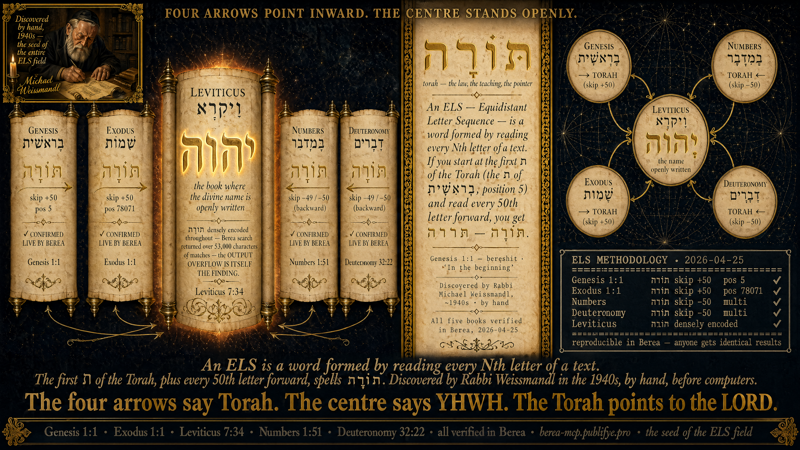
word_study(number="H8451")
תורה (tōrāh) — H8451
"The law of the LORD is perfect, converting the soul" (Psalm 19:7)
| Source | What Berea returns |
|---|
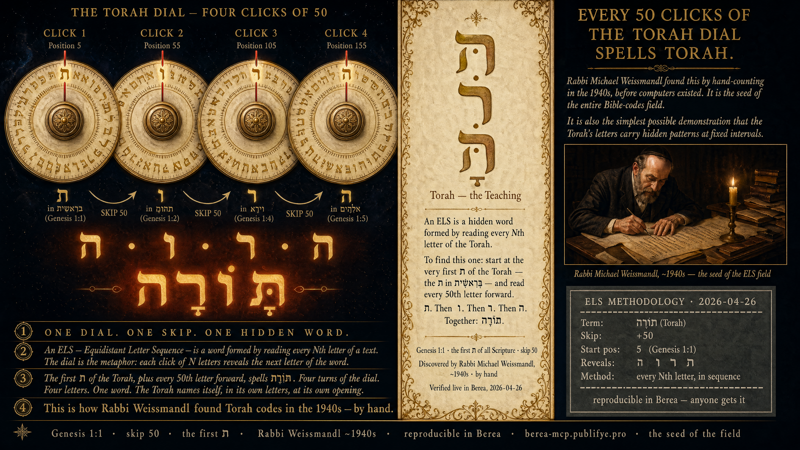
| Strong’s | A precept or statute, especially the Decalogue or Pentateuch. From root ירה (yarah, H3384) — “to throw, to shoot, to point out, to TEACH.” |
| Meaning | תורה is not “law” (Greek νόμος, nomos). It is “instruction, teaching, guidance” — from a verb meaning to aim an arrow. |
| Frequency | 219 OT occurrences. Gematria: ת(400)+ו(6)+ר(200)+ה(5) = 611. The 611 + 2 commandments heard directly from God = 613 mitzvot. |
The greatest mistranslation in the Bible may be תורה as “law.” The root means to aim, to point, to teach. Torah is not legislation — it is a father pointing the way. And its gematria (611) plus the 2 commandments Israel heard from God’s own voice = 613.
get_cross_refs(ref="Jeremiah 29:11")
Jeremiah 29:11 — 35 Cross-References
"For I know the plans I have for you, declares the LORD, plans for welfare and not for evil."
| Connection | Reference |
|---|
| God’s plans stand forever | Psalm 33:11 |
| His thoughts toward us are many | Psalm 40:5 |
| I know the thoughts I think | Zechariah 8:14–15 |
| New covenant promise | Jeremiah 31:1–33 |
| Restoration promised | Zephaniah 3:14–20 |
35 cross-references. The Hebrew מחשבות (“plans/thoughts”) is from חשב — the same root as “reckoned” in Genesis 15:6. God’s plans for you and your faith being “reckoned” as righteousness — same verb, same God, same intention.