The Loop
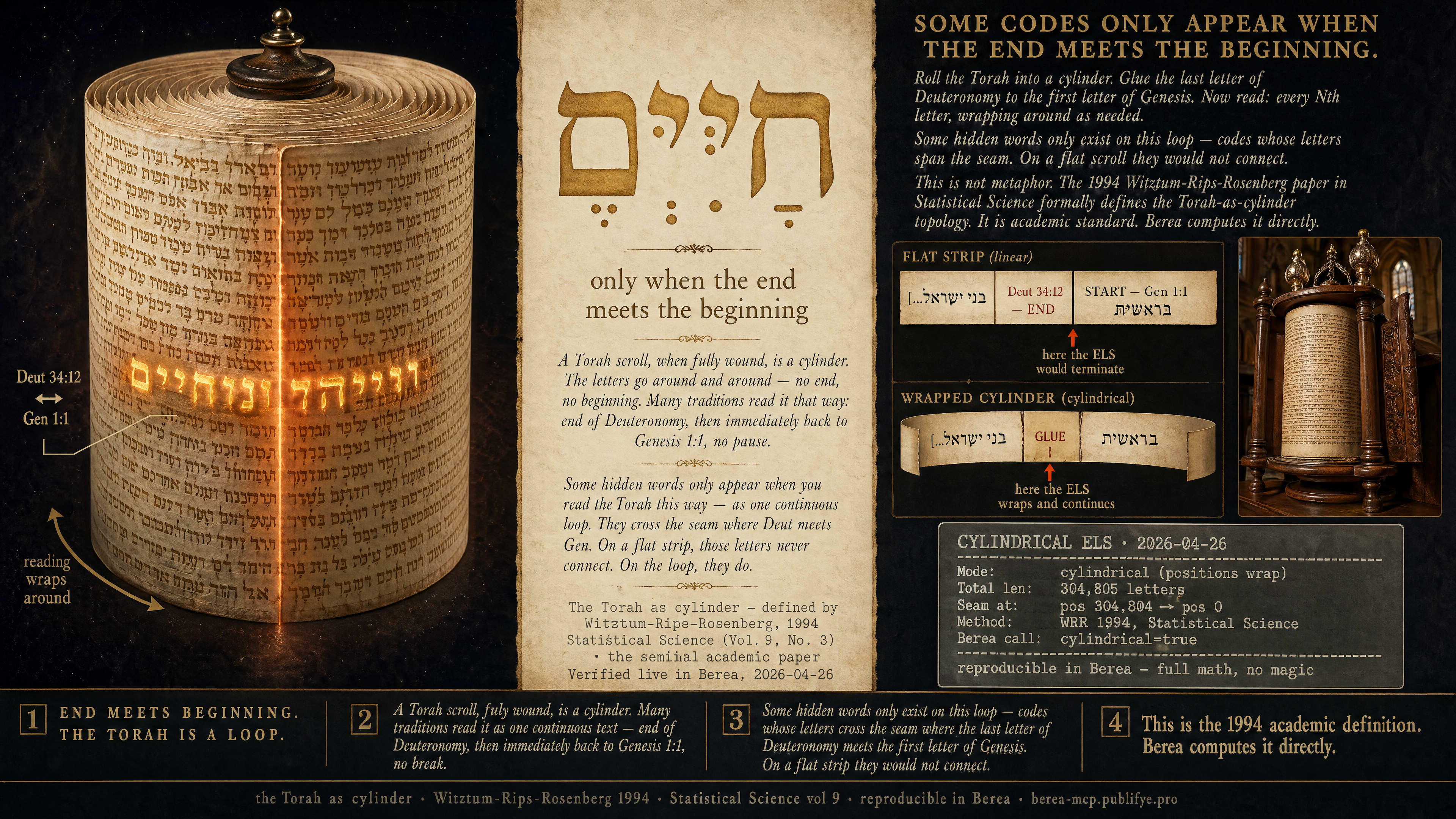
The third lens-view from the Cone. A literal Torah scroll wound into a closed cylinder — its two parchment edges glued at the seam where Deuteronomy meets Genesis. Some hidden words exist ONLY when the Torah is read this way — codes whose letters straddle the seam. The cylindrical topology formally defined by Witztum-Rips-Rosenberg in Statistical Science, 1994.
What this poster is
The third lens-view from the Cone (00B). Here the dial closes into a TRUE LOOP — the Torah as a continuous cylinder where the last letter of Deuteronomy 34:12 connects directly to the first letter of Genesis 1:1. Some hidden words exist ONLY when the Torah is read this way — codes whose letters straddle the seam.
The physics
A Torah scroll, when fully wound, IS a cylinder. The Jewish liturgical year reads it that way: end of Deuteronomy on Simchat Torah, then immediately back to Genesis 1:1 — no break, no pause. The text is one continuous stream that loops.
The math (WRR 1994)
The seminal academic paper on Bible codes — Witztum, Rips, Rosenberg, Statistical Science 9(3), 1994 — formally defined the cylindrical topology:
"We may think of the two vertical edges of the array as pasted together with the end of the first line pasted to the beginning of the second line… We thus get a cylinder on which the text spirals down in one long line."
ELS pairs in Genesis form more compact geometric patterns on the cylinder's surface than expected at random.
Why it matters
Some codes only exist on the loop. A 4-letter ELS starting near Deuteronomy 34:12 with a forward skip would terminate before reaching Genesis 1:1 on a flat strip — but on the cylinder, the skip wraps and continues. Berea computes both modes directly via cylindrical=true in the search API.
Reproducibility
berea call els_search term="<word>" cylindrical=true
berea call els_search term="<word>" cylindrical=false
The DIFFERENCE between the two result sets is the cylindrical-only set.
Visual hinge
A literal Torah scroll wound into a closed cylinder — its two parchment edges glued together at the seam where Deuteronomy 34:12 meets Genesis 1:1. Around the cylinder's surface: the Torah's Hebrew letters in dense gold calligraphy. At the seam, a hidden word glows — its letters straddling the boundary. The Torah as one continuous loop, the way the 1994 academic paper defined it, the way many traditions have always read it.
Citations
- Witztum D., Rips E., Rosenberg Y., "Equidistant Letter Sequences in the Book of Genesis," Statistical Science 9(3), 1994.
- Berea
els.go:835 SearchCylindrical()andwrapPos()line 737 implement this topology directly.
Source
Render: OpenAI Image 2 (gpt-image-2), 2026-04-26 18:52 CEST, single-pass landing.