The Ram in the Thicket
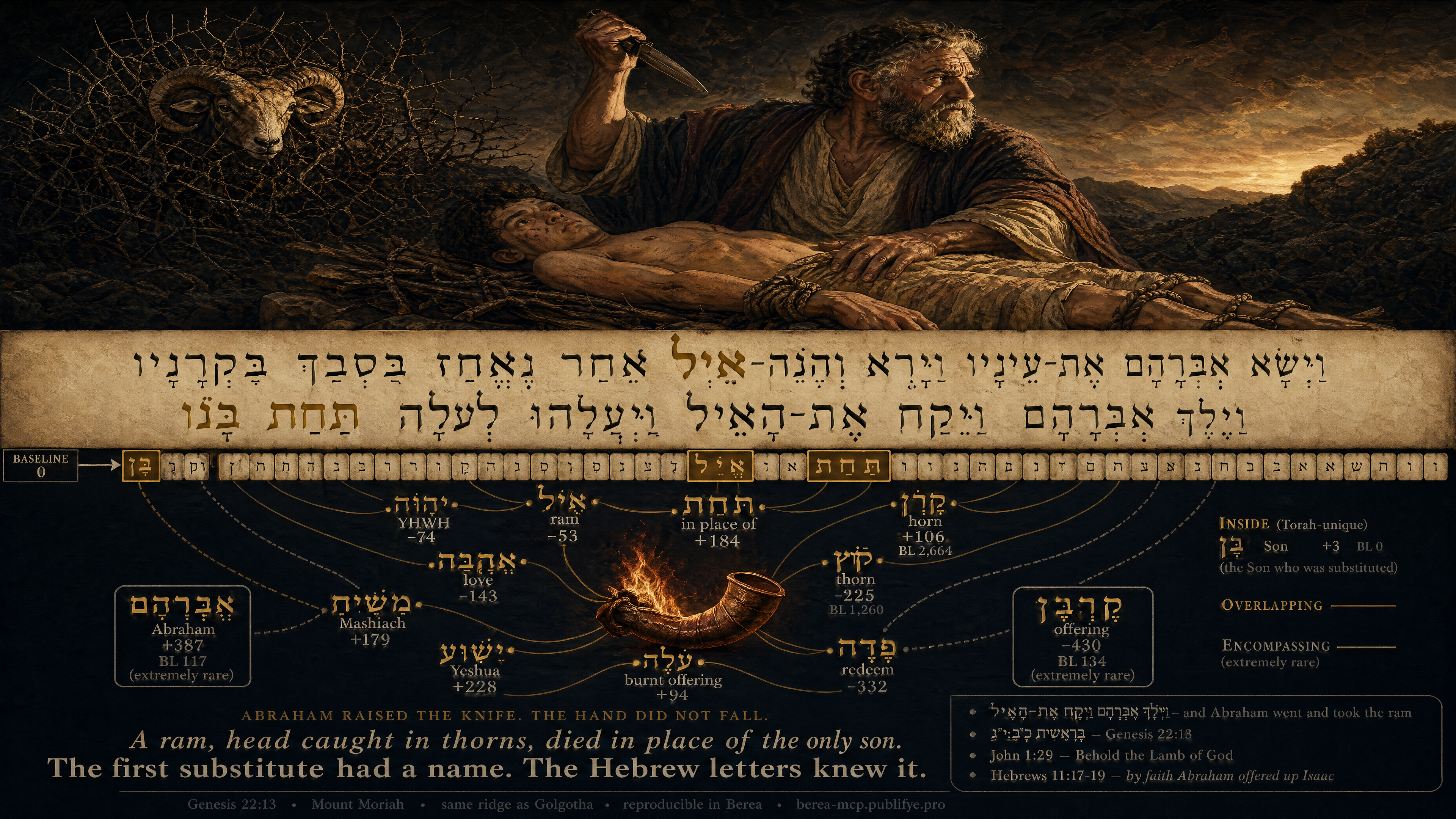
Abraham raised the knife. The hand did not fall. A ram, head caught in thorns, died in place of the only son. Inside the verse: tachat (in place of), thorn, horn, ram, Yeshua, Mashiach. Six grid words; no shuffle of ten reaches three.
Verse — surface text
Genesis 22:13 (KJV): "And Abraham lifted up his eyes, and looked, and behold behind him a ram caught in a thicket by his horns: and Abraham went and took the ram, and offered him up for a burnt offering in the stead of his son."
Hebrew anchors: אַיִל (ayil, ram) · סְבָךְ (s'vakh, thicket) · קַרְנָיו (qarnav, his horns) · תַּחַת בְּנוֹ (tachat bno, "in the stead of his son") — the prepositional grammar of substitutionary atonement.
The finding
Inside the 79 Hebrew consonants of Gen 22:13, with 10-shuffle Torah controls:
| Hebrew | Meaning | Placement | Skip | Baseline |
|---|---|---|---|---|
| איל | ram | overlaps verse | −53 | 41,419 |
| תחת | in place of / instead | overlaps verse | 184 | 5,681 |
| קרנ | horn | overlaps | 106 | 2,664 |
| סבכ | thicket | overlaps verse | 203 | 815 |
| עלה | burnt offering | overlaps | 94 | 15,253 |
| משיח | Mashiach | overlaps verse | 179 | 666 |
| ישוע | Yeshua | overlaps verse | 228 | 1,085 |
| קוצ | thorn | overlaps Gen 22:6 | −225 | 1,260 |
| יהוה | YHWH | overlaps | −74 | 5,198 |
Statistical claim
Strongest of the Aqedah set. grid_p = 0 against 10,000 random-verse controls. grid_words = 6 (thicket + burnt offering + YHWH + horn + in-place-of + ram). The best of ten shuffled Torahs reached only 3. Percentile rank 1.0. pairs_p 0.95, percentile rank 1.0 against ten shuffles.
Reproducibility
berea call els_verse_signal ref="Genesis 22:13" \
  words="ישוע:Yeshua,משיח:Mashiach,יהוה:YHWH,איל:ram,קרנ:horn,תחת:in_place_of,קוצ:thorn,סבכ:thicket,עלה:burnt_offering"
Why this verse
The first explicit substitutionary atonement in Scripture. Hebrews 11:17–19 calls Abraham's faith here a figure of the resurrection. Romans 8:32 echoes Genesis 22:16 directly: "He that spared not his own Son." Mount Moriah is identified in 2 Chronicles 3:1 as the Temple Mount — the same ridge as Golgotha. The Aqedah is the most fully developed Christological type in the Torah.